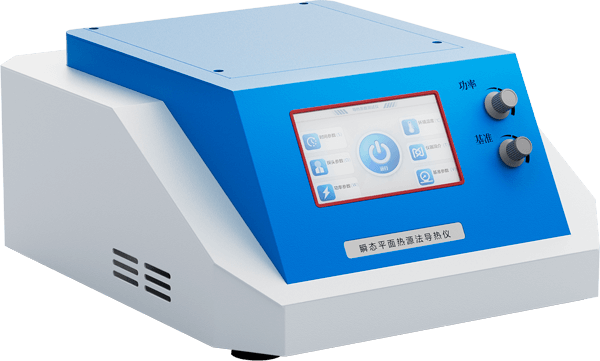
Thermal Conductivity Tester
- Product Number:LD-DR1
- Product Difference:Transient plane heat source method, thermal conductivity range 0.005–300 [W/(m·K)], measurement time 5–160 s
 +86 19353291814
 Online Consultation
Product Introduction
DR1 is a thermal conductivity tester developed using Transient Plane Source (TPS) technology, suitable for measuring the thermal conductivity of various materials. TPS represents a novel approach in thermal conductivity research, elevating measurement techniques to a new level. It enables rapid and accurate thermal conductivity measurements during material analysis, offering significant convenience for industrial quality control, material production, and laboratory research. The instrument is user-friendly with straightforward operation and causes no damage to test specimens.
Transient Plane Source (TPS) technology represents an innovative approach for measuring thermal conductivity. Its principle of determining thermal properties is based on the transient temperature response generated by a disk-shaped heat source undergoing step heating within an infinite medium. A planar probe made of thermally resistive material serves simultaneously as both the heat source and temperature sensor. The thermal resistance coefficient of alloys exhibits a linear relationship between temperature and electrical resistance. Thus, monitoring resistance changes reveals heat loss, thereby reflecting the sample's thermal conductivity.
The probe employs a conductive alloy etched into a continuous double-helix structure. Its outer layer consists of a thin, dual-layer insulating protective coating, providing mechanical strength while maintaining electrical insulation from the sample. During testing, the probe is positioned at the sample's center. When current flows through the probe, it generates a temperature rise. The resulting heat simultaneously diffuses into the sample on both sides of the probe, with the diffusion rate dependent on the material's thermal conductivity. By recording the temperature and the probe's response time, the thermal conductivity coefficient can be directly derived using mathematical models.
Testing targets include metals, ceramics, alloys, ores, polymers, composites, paper, textiles, foamed plastics (flat-surfaced insulation materials, panels), mineral wool, cement walls, glass-reinforced composite panels (CRC), cement polystyrene boards, sandwich concrete, fiberglass panel composites, paper honeycomb panels, colloids, liquids, powders, granular and paste-like solids, and more, covering a wide range of materials.
Reference standards include GB/T 32064-2015 “Determination of Thermal Conductivity and Thermal Diffusivity of Building Materials by Transient Plane Source Method,” GB/T 42919.1-2023 “Plastics - Determination of Thermal Conductivity and Thermal Diffusivity,” and ISO 22007-1:2024 “Plastics - Determination of Thermal Conductivity and Thermal Diffusivity.”
Product Features
The instrument offers a wide testing range and stable performance, ranking among the top in its class domestically.
Direct measurement with configurable test durations of 5–160 seconds enables rapid and accurate thermal conductivity determination, significantly saving time.
Unlike static methods, it is unaffected by contact thermal resistance.
Requires no special sample preparation and imposes no specific shape requirements. Bulk solids need only have a relatively smooth surface and dimensions at least twice the probe diameter.
Performs non-destructive testing, enabling sample reuse.
The probe features a dual-helix design, combined with a proprietary mathematical model, utilizing core algorithms to analyze and compute data collected by the probe.
The sample stage boasts an ingenious structural design that is easy to operate, accommodates samples of varying thicknesses, and maintains a sleek, aesthetic appearance.
Data acquisition on the probe utilizes an imported data acquisition chip. Its high resolution ensures more accurate and reliable test results.
The host control system employs an ARM microprocessor, which operates faster than traditional microprocessors. This enhances the system's analytical processing capabilities and delivers more precise computational results.
The instrument can measure thermal property parameters for bulk solids, paste-like solids, granular solids, colloids, liquids, powders, coatings, films, insulation materials, and more.
Intelligent human-machine interface with color LCD display and touchscreen control ensures convenient and straightforward operation.
Robust data processing capabilities. Highly automated computer data communication and report processing system.
Product parameters
| Scope of Testing | 0.0001—300 W/(m*K) |
| Sample Temperature Range | -20°C to 200°C (requires optional external temperature control equipment) |
| Probe Diameter | Probe 1: 7.5mm; Probe 2: 15mm; Probe 3: 30mm |
| Accuracy | ±3% |
| Repeatability Error | ≤3% |
| Measurement Time | 5~160 seconds |
| Power Supply | AC 220V |
| Total Power Consumption | <500W |
| Sample Temperature Rise | <15°C |
| Sample Power P | Probe 1: 0<P<0.4W; Probe 2: 0<P<14W; Probe 3: 0<P<7W |
| Sample Specifications | Single sample measured by Probe 1 (15×15×3.75mm); Single sample measured by Probe 2 (30×30×7.5mm); Single sample measured by Probe 3 (60×60×20mm) |
| Note: Probe 1 measures thin, low-conductivity materials; Probe 2 is a standard universal probe; Probe 3 measures high-conductivity materials with greater thermal conductivity. Samples with smooth, flat surfaces and adhesive properties may be stacked for measurement. | |
 Prev
Prev Next
Next