Drinking Water Cation & Anion Detection Solution
Drinking Water Cation & Anion Detection Solution
——Empowering Enterprise Efficiency with Technology, Building Defenses for Drinking Water Safety
I. Background & Objectives
Drinking water safety is directly linked to public health. Throughout the entire chain — from source water, treatment, distribution to the tap — cationic and anionic substances (such as fluoride, chloride, nitrate, sulfate, sodium, potassium, calcium, magnesium, etc.) must be accurately monitored to ensure water quality remains within safe ranges and to maintain traceable, reliable data.
This solution combines laboratory-grade precision with smart, portable field capability, establishing a seamless workflow from sampling to result interpretation. The objectives are:
1. Simultaneous or independent multi-index detection without mutual interference, improving testing throughput.
2. Real-time data visibility for immediate decision-making, reducing reliance on delayed lab reports.
3. Flexible deployment in fixed laboratories and mobile field operations.
4. Compliance with rigorous technical principles to support credible supervision and quality control.
II. Core Testing Equipment
1. Ion Chromatograph
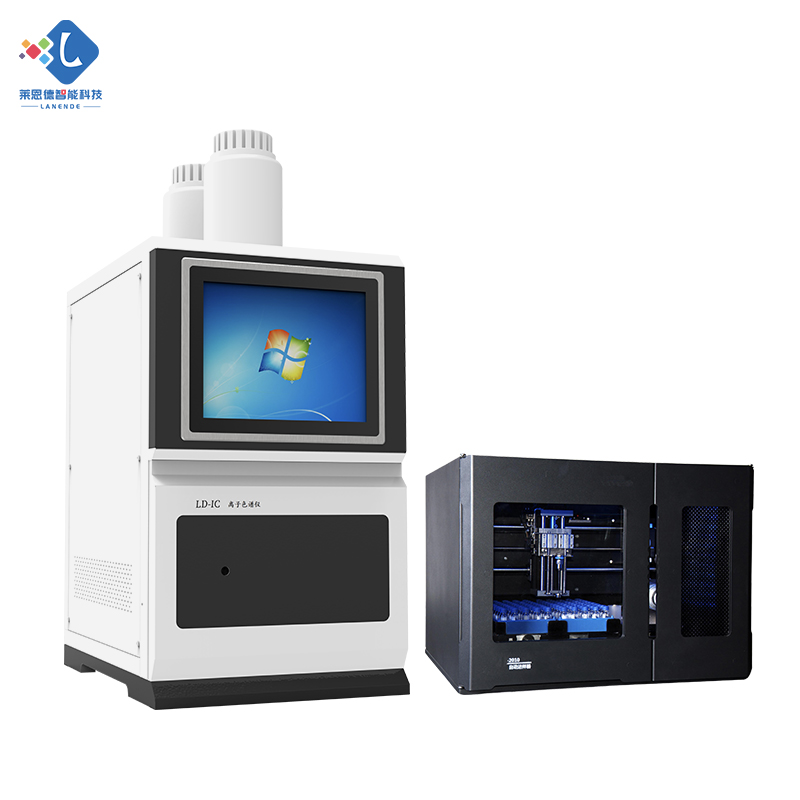
· Purpose: Accurate quantitative analysis of drinking water cations and anions, covering fluoride, chloride, nitrite, phosphate, bromide, nitrate, sulfate, as well as Li⁺, Na⁺, NH₄⁺, K⁺, Ca²⁺, Mg²⁺, Sr²⁺, Ba²⁺, etc.
· Key Advantages:
1. All-in-one design: Integrates host, eluent generator, industrial PC, and chromatography workstation — compact layout with minimal flow path to reduce peak broadening .
2. Integrated thermostat: Column, suppressor, conductivity cell, and amplifier share one temperature-controlled environment (±0.01 ℃), minimizing baseline drift and noise .
3. Smart control: 12.1 inch flat industrial PC with one click start for valve injection, shutdown, maintenance, and tutorial access .
4. High-sensitivity conductivity detection: Minimum detectable concentration ≤0.0005 µg/mL (as Cl⁻); quantitative repeatability ≤0.1% .
5. Automatic eluent generation: Uses only high-purity water, eliminating manual reagent preparation, enhancing stability and simplifying workflow .
6. Safety monitoring: Built-in leak and low-water alarms, plus overpressure protection for continuous safe operation .
· Applicable scenarios: Central labs of waterworks, health supervision testing centers, third-party labs.
2. Multi-parameter Water Quality Tester
· Purpose: Rapid on-site screening of pH, dissolved oxygen, conductivity, turbidity, temperature, and selected cation/anion indicators, serving as a frontline complement to the ion chromatograph.
· Key Advantages:
1. Android smart system with large touchscreen and built-in tutorials for quick operator onboarding.
2. Supports positioning and photo traceability; data can be uploaded instantly via WiFi/4G.
3. Expandable to over 120 measurement modes including COD, ammonia nitrogen, total phosphorus, total nitrogen, heavy metals, with extensive built-in standard curves .
· Applicable scenarios: Source water inspection, network endpoint sampling, emergency monitoring.
III. Testing Items & Significance
Category | Target Analytes | Significance |
Anions | Fluoride, chloride, nitrite, nitrate, sulfate, bromide, phosphate, etc. | Control harmful ion concentrations to prevent chronic toxicity and pipeline corrosion |
Cations | Li⁺, Na⁺, NH₄⁺, K⁺, Ca²⁺, Mg²⁺, Sr²⁺, Ba²⁺, etc. | Assess hardness, alkalinity, and risks from special ions (e.g., toxic Ba²⁺) |
Related Indicators | pH, conductivity, turbidity, residual chlorine | Reflect overall water condition and disinfection effectiveness |
IV. Implementation Approach
1. Sampling & Pretreatment
· Sampling points: Cover source water, outlet of treatment plants, main pipelines, and endpoints to ensure spatial representativeness.
· Sample preservation: Follow proper procedures for chilled transport to prevent changes in ionic form.
· Pretreatment: Filter samples through 0.45 μm membranes if turbid or containing organic interferences; add masking agents (e.g., EDTA) when necessary to remove heavy metal interference.
2. Laboratory Precision Testing (Ion Chromatography)
· Workflow:
1. Automatically generate eluent (suppressor regenerates online; stabilization ≤12 min).
2. Sample enters separation column via injection valve; anions/cations are separated sequentially.
3. Conductivity detector quantifies analytes; workstation auto-integrates peaks and generates reports.
· Data handling: Automatic storage (≥8 million datasets), Excel export, time-based retrieval, and optional QR code reporting.
3. Field Rapid Screening (Multi-parameter Tester)
· Workflow: Direct immersion of probes or use of cuvettes; obtain readings for pH, conductivity, turbidity, and some ions within minutes.
· Linkage mechanism: Mark abnormal sites and trigger confirmatory lab tests automatically, forming a “rapid screening + confirmation” closed loop.
4. Data Management & Intelligence
· Data from both laboratory and field devices are consolidated for centralized review, trend tracking, and anomaly alerts.
· Enables operators to adjust treatment processes proactively based on historical patterns and real-time variations.
V. Value of the Solution
· Assured compliance: Adheres to strict technical principles aligned with drinking water safety requirements.
· Precision & efficiency: Combines laboratory-grade ion chromatography with fast field screening for both depth and responsiveness.
· Full-chain traceability: From sampling location marking to testing and result recording, ensuring every step is verifiable.
· Technology empowerment: Intelligent, connected testing system reflects our core belief — “Technology empowers enterprise efficiency.”
· Flexible adaptation: Dual-mode operation (fixed lab + mobile field) satisfies routine monitoring, spot checks, and emergency needs.
VI. Supporting Services
· Training: Comprehensive instruction on instrument operation, method validation, and data handling for immediate proficiency.
· Maintenance & calibration: Regular calibration, suppressor regeneration, software updates to ensure long-term reliability.
· Customization: Tailored testing items and report formats based on local water characteristics and operational priorities.
· Emergency response: On-site equipment support and rapid method optimization during unexpected contamination events.
> Designed around Leader Intelligent Technology’s Ion Chromatograph and Multi-parameter Water Quality Tester, this solution integrates precise laboratory analysis with rapid field screening, helping water suppliers, regulators, and testing institutions establish a scientific, efficient cation/anion detection system for safer drinking water and streamlined quality management.
 Prev
Prev Next
Next