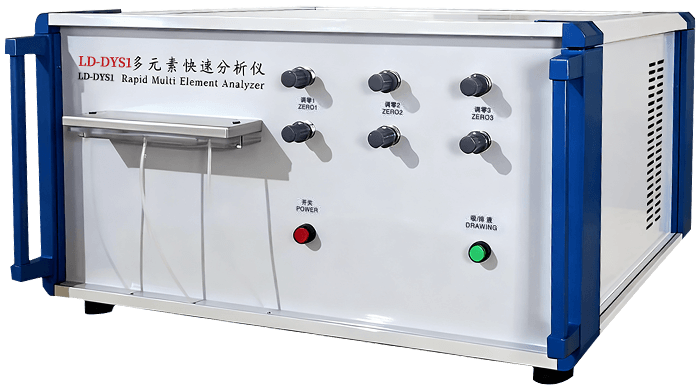
Multi-element Rapid Analyzer
- Product Number:LD-DYS1
- Product Difference:Tests for 3 elements in a single test
 +86 19353291814
 Online Consultation
Product Introduction
The Multi-Element Rapid Analyzer is a device developed based on the principles of photometric analysis. It operates on the linear relationship between sample concentration and readings; within the range governed by Beer’s Law, the linearity is optimized to ensure more precise measurement results.
It offers significant advantages for systematic analysis in the silicate industry and has been adopted by thousands of users across various sectors, including ceramics, refractory materials, cement, glass, geology, and non-metallic minerals (including research institutes and universities). The instrument has also entered the international market in large quantities and has received widespread acclaim from users.
Sample types: feldspar, clay, kaolin, quartz, limestone, wollastonite, talc, dolomite, ceramic powders, glazes, frits, bauxite, corundum, aluminum oxide, magnesium oxide, and other silicate, aluminate, high-calcium, and high-magnesium samples or ores. White corundum, sub-white corundum, fused corundum, flake corundum, zirconia corundum, aluminum oxide powder, metallic aluminum powder, metallic silicon powder, silicon carbide, α-aluminum oxide, brown corundum, bauxite, pyroxene, andradite, olivine, talc, dolomite, wollastonite, cordierite, mullite, zirconium mullite, magnesium-aluminum spinel, limestone, calcite, potassium-sodium feldspar, diopside, spodumene, lithium feldspar, lithium mica, phospho-lithium-aluminum ore, fluorite, quartz sand, quartz powder, silica fume, white silica fume, perlite, magnesia-chrome bricks, high-alumina cement, aluminate cement, refractory mortar, Portland cement, zircon sand (powder), zirconium silicate, zirconium oxide, magnesia, magnesium powder, manganese powder, Kyanite, kyanite, sillimanite, micaceous schist, aluminum hydroxide, calcium aluminate, various clays, kaolin, kaolinite, bentonite, sepiolite, sericite, basalt, slag, briquettes, rod powder, etc.
Product Features
By employing a unique method of linear extension and sensitivity enhancement, this approach resolves the issues inherent in traditional photometric analysis—namely, deviation from linearity when analyzing high-concentration components and poor sensitivity when analyzing low-concentration components.
Analytical accuracy: Complies with GB/T 4734, QB/T 2578-2002 (Permissible Errors in the Analysis of Ceramic Materials), and GB/T 6900 (Permissible Errors in the Analysis of Refractory Materials).
Analysis speed: Completes the analysis of eight major elements in a single sample within 5 minutes, and routine elemental analysis of eight samples within 20 minutes.
Product parameters
| Model | LD-DYS1 | LD-DYS2 |
|---|---|---|
| Measurement Channels | 3 | 6 |
| Elements Measured in a Single Run | 3 elements | 6 elements |
| Analysis Standards | GB/T4734, GB/T6900, QB/T2578-2002 | |
| Analysis Speed | Completes analysis of eight major elements for one sample within 5 minutes Completes routine element analysis for eight samples within 20 minutes | |
| Number of Samples for Continuous Measurement | 20 | |
| Power Supply | 220V/50Hz | 220V/50 & 60Hz |
| Total Power Consumption | 1 kW | |
| Installation Area | 3500mm × 850mm workbench | |
| Ambient Temperature | 10–30°C | |
| Relative Humidity | ≤85% | |
Measurement of Oxide Concentration
| Name | Content | Name | Content | Name | Content | Name | Content |
| Silicon dioxide | 0.1-99% | Aluminum oxide | 0.1-99% | Iron(III) oxide | 0.1–99% | Titanium dioxide | 0.1–99% |
| Potassium oxide | 0.1–99% | Sodium oxide | 0.1–99% | Calcium oxide | 0.1–99% | Magnesium oxide | 0.1–99% |
| Boron trioxide | 0.1–30% | Zirconium oxide | 0.1–99% | Lithium oxide | 0.1–15% | Tin oxide | 0.1-99% |
| Lead oxide | 0.1-99% | Zinc oxide | 0.1-99% | Manganese oxide | 0.1-99% | Chromium trioxide | 0.1–99% |
| Barium oxide | 0.1–10% | Nickel oxide | 0.1–15% | Cobalt oxide | 0.1–10% | Phosphorus pentoxide | 0.1–30% |
| Copper oxide | 0.1–99% | Vanadium pentoxide | 0.1–99% |
 Prev
Prev Next
Next