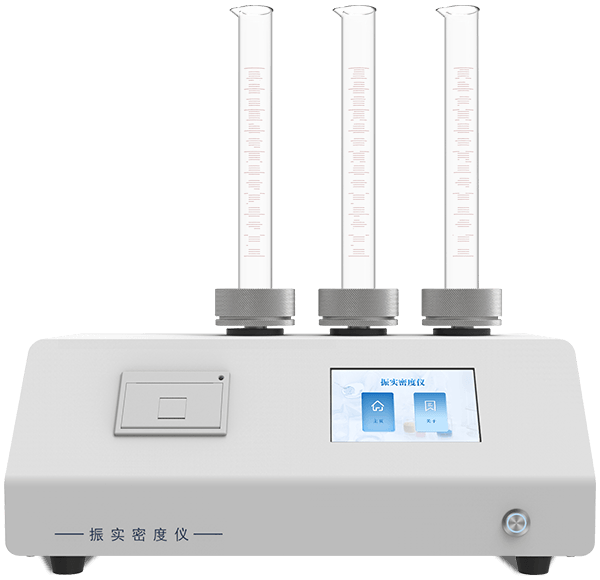
Tapped Density Tester
- Product Number:LD-ZS3
- Product Difference:Three-station system for accurately determining the density of powdered or granular materials in a compacted state
 +86 19353291814
 Online Consultation
Product Introduction
A tap density tester is a high-precision instrument that simulates the vibration conditions encountered in actual operating environments to accurately measure the density of powdered or granular materials in a compacted state. Its core function is to evaluate changes in material volume during the compaction process, providing critical data support for industrial production, research and development, and quality control.
Widely used in the defense industry, papermaking, cement, battery manufacturing, coatings, and various metal and non-metal industries, it is the ideal equipment for density testing. Metal powders: such as aluminum powder, zirconium powder, nickel powder, tungsten powder, tin powder, zinc powder, molybdenum powder, magnesium powder, copper powder, and other rare metal powders. Non-metallic powders: such as talc powder, kaolin, calcium carbonate, coal powder, phosphors, magnesite, calcite, wollastonite, tourmaline, diamond, barite, fluorite, zeolite, boron carbide, clay, graphite, quartz, gypsum, bentonite, diatomaceous earth, zirconium silicate, corundum, mica, clay, titanium dioxide, etc.
The principle of vibration involves placing a measured quantity of powder into a measuring cylinder. While maintaining the original particle morphology, the powder undergoes uniform, reciprocating linear motion up and down via a vibrating device, causing the gaps between particles to narrow to a limit until the powder’s volume no longer decreases. The sample’s tapped density is obtained by dividing the powder’s mass by its volume after tamping.
Product Features
Features a 5.0-inch touchscreen, providing a convenient and simple human-machine interface.
Utilizes an embedded microprocessor, offering high performance and low power consumption.
Equipped with long-life, highly reliable motors and drive components, offering excellent start-stop response capabilities.
The user interface is intuitive and easy to use, featuring a coherent and logical layout with a user-friendly aesthetic design.
Features a built-in embedded mini receipt printer.
Measurement results are accurate to three decimal places.
The instrument operates stably, has a robust structure, and features an attractive appearance.
Product parameters
| Measuring cylinder | 25 ml, 100 ml, optional 250 ml |
| Amplitude | 3 mm (±0.1 mm), 14 mm (±1 mm) optional |
| Density Range | 0.1 g/ml to 19.9 g/ml |
| Repeatability | Error ≤1% |
| Reliability | Continuous operation for 8 hours |
| Tamping method | Up-and-down vibration + rotation |
| Flow index | Hausner ratio, Karl Coefficient |
| Data Processing | Automatic calculation after single measurement |
| Vibration Frequency | 1–300 cycles/minute (adjustable) |
| Vibration Duration | 0–60 minutes |
| Operating Environment | -20°C to 50°C |
| Operating Voltage | AC 220V ±10%, 50 Hz |
| Dimensions and Weight | 43 cm × 26 cm × 20 cm, 15.0 kg |
 Prev
Prev Next
Next