Antibiotic Residue Detection Scheme in Aquatic Products
Practice of "Technology Empowers Enterprise Efficiency" by Lanende Intelligent Technology
I. Background and Objectives of the Scheme
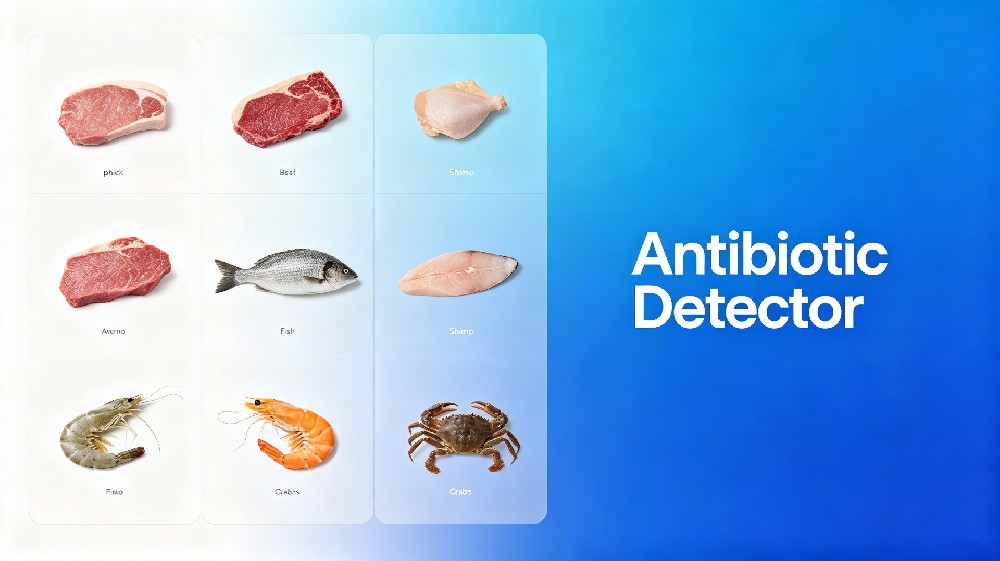
Antibiotic residues in aquatic products (such as chloramphenicol, malachite green, nitrofuran metabolites, sulfonamides, quinolones, etc.) are crucial risk factors affecting food safety and international trade. Based on the risk prevention and control concept covering the whole chain of breeding-processing-circulation, this scheme integrates rapid screening and accurate quantitative detection. It helps aquatic farms, processing enterprises, inspection and quarantine authorities, and market supervision departments realize controllable sources, traceable processes and preventable risks, practicing the core concept of technology empowering enterprise efficiency.
II. Test Objects and Risk Points
Test Categories
Live and frozen aquatic products including fish, shrimp, crab, shellfish, etc.
Main Risk Substances
• Forbidden Drugs: Chloramphenicol, Malachite Green, Nitrofuran Metabolites (Furazolidone, Nitrofural, Furaltadone, Nitrofurantoin)
• Antibiotics: Sulfonamides, Quinolones, Tetracyclines, β-Lactams, Macrolides
• Hormones: Clenbuterol Hydrochloride, Ractopamine, Salbutamol, etc.
Risk Links
Drug use in breeding, transportation and preservation, raw material acceptance before processing, random inspection in market circulation
III. Testing Basis and Standards
• GB 31650-2019 National Food Safety Standard - Maximum Residue Limits for Veterinary Drugs in Animal Foods
• List of forbidden drugs in Announcement No. 250 of the Ministry of Agriculture and Rural Affairs
• Relevant limit requirements of Codex Alimentarius Commission (CAC), EU and US FDA
• The coincidence rate between detection limits of Lanende instruments and national standard methods ≥98%, ensuring data availability for law enforcement and export compliance
IV. Technical Testing Scheme
1. Equipment Selection and Functions
Detection Level | Equipment Name | Core Functions | Technical Advantages | Application Scenarios |
On-site Rapid Detection | Integrated Detector for Chloramphenicol and Malachite Green in Aquatic Products (LD-SCG) | Simultaneous detection of chloramphenicol, malachite green, nitrofuran metabolites, sulfonamides, heavy metals, etc. | Electrochemistry + Spectroscopy + Immunochromatography; single batch in 10 minutes; portable suitcase design; Android system with automatic calibration and data upload | On-site screening at farms, wharves and markets |
Multi-parameter Screening | Integrated Aquatic Product Safety Detector | Integrates immunochromatography and photoelectric colorimetry to detect histamine, total volatile basic nitrogen (TVB-N), chloramphenicol, malachite green, formaldehyde, heavy metals | 12-channel simultaneous detection; results in 15 minutes; real-time early warning via supervision platform interface | Raw material acceptance in processing enterprises, rapid inspection stations in agricultural markets |
Accurate Quantitation | Antibiotic Residue Detector | Colloidal gold immunochromatography + fluorescence quantitation for detection of penicillins, sulfonamides, quinolones | Detection limit as low as 0.1 ppb; 6-channel constant temperature metal bath; automatic generation of traceable reports | Export filing, laboratory confirmation |
Laboratory Full-featured | Multi-functional Food Safety Detector | Modular expansion to 200+ indicators covering pesticide residues, veterinary drug residues, additives, heavy metals | Android system with automatic prefabricated reagent identification; supports both spectrophotometry and colloidal gold modes | Quality inspection centers, third-party testing institutions |
2. Core Technical Principles
• Immunochromatography: Based on specific antigen-antibody binding, for rapid qualitative or semi-quantitative analysis, suitable for high-frequency on-site screening.
• Fluorescence Quantitation / Time-resolved Fluorescence: High sensitivity and low background interference, realizing accurate quantitation of trace residues.
• Electrochemical and Spectral Analysis: Quantify drug concentration through current signal or absorbance change, suitable for simultaneous multi-index detection.
• Non-destructive Testing Technology: Direct detection of frozen aquatic products through packaging, adapting to real-time monitoring of cold-chain logistics.
3. Testing Process
1. Sample Collection and Pretreatment
○ Collect muscle or visceral tissues according to standard sampling methods, homogenize and centrifuge to remove fat.
○ Adopt high-speed homogenizer, vortex mixer and nitrogen evaporator to improve extraction efficiency.
2. Rapid Screening (On-site / Enterprise Self-inspection)
○ Use LD-SCG and other instruments to complete multi-index detection in 10~15 minutes.
○ Automatic interpretation, generate QR code reports, and upload data to the supervision platform in real time.
3. Confirmatory Testing (Laboratory)
○ Conduct quantitative re-inspection of positive samples with antibiotic residue detector or multi-functional detector.
○ Data docking with LIMS system to form a complete traceability archive.
4. Result Disposal
○ Reject unqualified raw materials and record supplier information.
○ Automatic early warning on the supervision platform, triggering re-inspection or law enforcement procedures.
V. Scheme Highlights and Advantages
• Whole-chain Coverage: Closed-loop management from breeding drug monitoring, self-inspection before leaving the pond, processing acceptance to market circulation random inspection.
• Dual Guarantee of Speed & Accuracy: On-site rapid detection shortens the cycle to 10~15 minutes, and laboratory confirmation ensures the legal validity of data.
• Data Interconnection & Traceability: Supports WiFi/4G/GPRS wireless transmission; test results can be uploaded to "Smart Food Safety" platform or enterprise ERP in real time, forming tamper-proof traceability archives.
• Portability & Intelligence: Lightweight equipment design, outdoor battery life ≥8 hours; Android system + instructional videos reduce operation threshold.
• Cost Reduction & Efficiency Improvement: Multi-functional equipment replaces multiple single-function instruments, reducing procurement and operation costs by 25%~30% and improving detection efficiency by more than 3 times.
VI. Typical Application Scenarios
• Large-scale Fish and Shrimp Farms: Establish a three-in-one system of "disease early warning + veterinary drug residue self-inspection + water quality monitoring" to reduce disease losses and risks of excessive drug residues.
• Aquatic Products Processing / Import & Export Enterprises: Non-destructive testing of raw materials in storage + cold-chain data linkage to ensure export pass rate and avoid trade barriers.
• Market Supervision and Inspection & Quarantine: Mobile rapid inspection law enforcement scheme, issuing on-site QR code reports in 15 minutes to realize a closed loop of "detection-warning-disposal".
• Major Event Support: Mobile random inspection of mycotoxins and aquatic product veterinary drug residues by grassroots supervision, results in 8 minutes for rapid response to emergencies.
VII. Conclusion
Relying on Lanende Intelligent Technology's technological accumulation in the field of food safety detection, combined with the Internet of Things, big data and intelligent operating systems, this scheme transforms complex antibiotic residue detection into a controllable, repeatable and traceable standardized process. It helps enterprises significantly improve detection and management efficiency while ensuring product safety. This is not only the implementation of technology, but also an in-depth practice of technology empowering enterprise efficiency in the food safety sector, providing solid support for global aquatic product quality safety and trade facilitation.
 Prev
Prev Next
Next