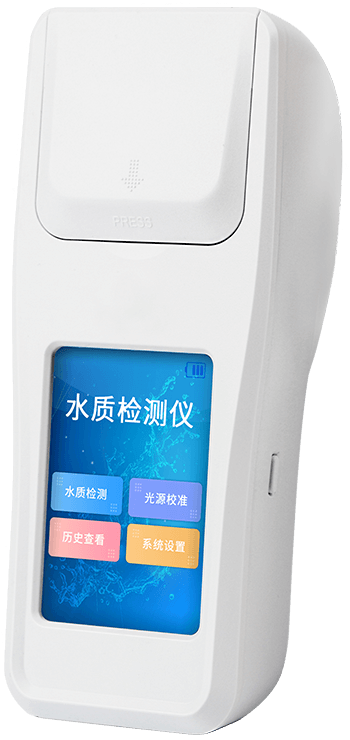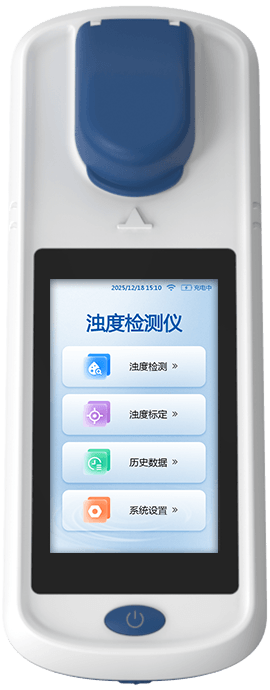
Handheld Turbidity and Suspended Solids Meter
- Product Number:LD-SXTS
- Product Difference:High-precision turbidity and suspended solids detection, measurement range 0–2000 (scattering method)
 +86 19353291814
 Online Consultation
Product Introduction
Turbidity is a key water quality indicator that measures the concentration of suspended particles in water; its value directly affects the water’s sensory characteristics and safety.
This instrument uses a single-wavelength (860 nm) scattered light measurement method to accurately determine turbidity. It also supports user-defined coefficients to convert turbidity values into suspended solids concentration, enabling the measurement of two parameters with a single device. Integrating optical and intelligent technologies, the instrument features powerful functions such as one-touch calibration, rapid response, a large display screen, and data storage. At the same time, it is lightweight and portable, offers long battery life, and boasts a high protection rating, enabling it to easily handle various harsh field environments. It is primarily used in water treatment plants, environmental monitoring, wastewater treatment, food and beverage, and aquaculture sectors, providing you with effective and professional on-site water quality testing solutions, making it an ideal tool for water quality management.
The detection principle is based on the scattered light method, which utilizes a stable light beam passing through a sample cell containing the sample to be tested, with the sensor positioned perpendicular to the emitted light to measure the intensity of the scattered light. The intensity of the scattered light generated when the beam enters the sample is proportional to the turbidity within a certain concentration range.
Under conditions where the water source, water quality, and operating conditions are relatively stable, the composition and particle size distribution of waterborne particles remain largely consistent. The mass concentration of suspended solids exhibits a stable, linear empirical correlation with the optical scattering signal of turbidity. Based on the empirical correlation coefficient between turbidity values and suspended solids concentration (e.g., 1 NTU ≈ 1 mg/L, initial setting), the instrument can convert turbidity measurements into suspended solids concentration values in real time.
Applications include the following areas: Environmental monitoring: Assessing turbidity in rivers, lakes, and groundwater. Water Supply Industry: Daily inspections of water quality throughout the treatment process (from raw water to filtered water) and in distribution networks. Wastewater Discharge Facilities and Wastewater Treatment Plants: Turbidity monitoring of influent, effluent, and treatment processes. Aquaculture: Ensuring the environmental health of aquaculture water bodies. Food and Beverage, Pharmaceutical Industries: Monitoring the quality of process water and cleaning water.
Product Features
Based on the Android operating system, it features an attractive interface and user-friendly operation.
Equipped with a 4.3-inch HD touchscreen and a visual graphical user interface, it significantly improves operational efficiency.
It uses highly reliable imported LED light sources that require no warm-up and offer long-term stable performance.
Equipped with a large 10×10 mm photodiode, offering high sensitivity and a low detection limit.
The instrument features 16 GB of internal storage, capable of saving over 10,000 records, and supports an optional Bluetooth printer for on-site printing of test results.
Equipped with Wi-Fi and Bluetooth functionality, as well as a USB port for direct connection to a PC to quickly upload data in batches.
The device is waterproof, and the detection chamber is protected against the ingress of up to 0.5 ml of liquid.
Uses a standard USB-C 5V/2.1A port supporting the BC2.1 charging protocol; compatible with third-party phone chargers, charging cables, and power banks; features intelligent lithium-ion battery management for extended use while plugged in.
Employs averaging measurement and automatic range switching.
The default display unit is NTU; other units—FAU, FNU, FTU, EBC, ASBC, and mg/L—can be switched manually.
Supports continuous multi-point turbidity calibration, zero-point calibration, and built-in standards.
Bilingual (Chinese/English) operating system.
Product parameters
| Measurement Method | Scattering Method |
| Light Source | LED |
| Light Source Wavelength | 860 nm |
| Measurement Range | 0–2000 NTU |
| Suspended Solids Range | Range corresponds to turbidity; displayed value = turbidity value × user-set coefficient |
| Resolution | 0.001 NTU |
| Suspended Solids Resolution | (0.001 × Setting Coefficient) mg/L |
| Indicated Value Error | ±6% |
| Repeatability | ≤0.5% |
| Zero Drift | ±0.5% FS/30 min |
| Reading Stability | ±0.5% FS/30 min |
| Protection Rating | IP65 |
| Operating Environment | Temperature 5–40°C; Humidity <85% |
| Power Supply | USB-C 5V 2.1A, supports BC2.1 protocol |
| Battery Capacity | 8000mAh |
| Dimensions & Weight | 246mm × 59.4mm × 84mm (L × W × H), 0.59 kg |
 Prev
Prev Next
Next