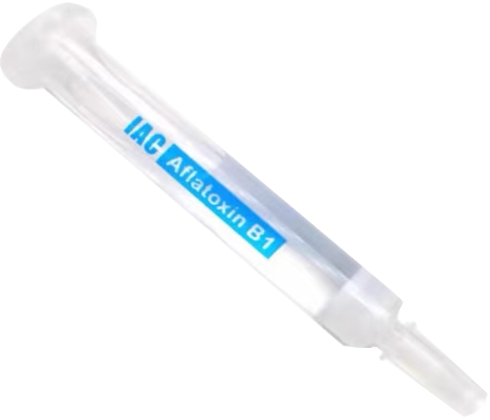
Aflatoxin M1 Immunoaffinity Column
- Product Number:IAC-AFM1
- Product Difference:Detection of grains, oils, feed, cereals, etc., with a detection limit of 100 ng, column capacity of 3 ml, and specifications of 25 columns per box
 +86 19353291814
 Online Consultation
Product Introduction
This series of immunoaffinity columns exhibits high selectivity for enriching and purifying mycotoxins present in food, feed, grains, and similar materials. Featuring straightforward operation and high recovery rates, they are suitable for sample preparation and precise analytical testing.
Product Features
High Specificity: Efficiently identifies target substances
High Stability: RSD < 5%
High Recovery Rate: Spiked recovery rates reach 90%–105%
High column efficiency: Stable flow rate minimizes column blockage
Strong enrichment capability: Efficiently adsorbs target substances for enhanced detection
Powerful purification capability: Eliminates interfering substances to improve detection accuracy
Broad applicability: Compliant with mainstream official analytical methods, suitable for toxin detection standards in GB5009 series and various pharmacopoeias
Product parameters
1. Prior to use, allow the affinity column to return to room temperature (22–25°C).
2. Store the affinity column at 2–8°C; do not freeze.
3. Do not use affinity columns beyond their expiration date.
4. Sample volume: Adjust sample volume as needed, ensuring the extraction solution volume is correspondingly modified.
5. Column capacity: 100 ng. If the toxin concentration in the sample divided by the dilution factor exceeds the column capacity, reduce the sample volume accordingly.
6. pH: The pH of the sample solution must be between 6–8. Adjust pH with hydrochloric acid or sodium hydroxide if outside this range.
7. Using the same solvent as the mobile phase during instrument analysis eliminates solvent effects.
8. Aflatoxin M1 is carcinogenic; gloves must be worn during handling.
9. Used containers and aflatoxin M1 solutions should be soaked overnight in sodium hypochlorite solution (5% v/v).
10. If milk powder samples are difficult to dissolve, allow them to stand at 50°C for 30 minutes. If dissolution still fails, increase the proportion of water used for dissolution.
 Prev
Prev Next
Next